
Evidensia

Admissibility of partnerships between veterinarians and business economists
Admissibility of partnerships between veterinarians and business economists 768 1024 Sven Jan Arndt

Background:
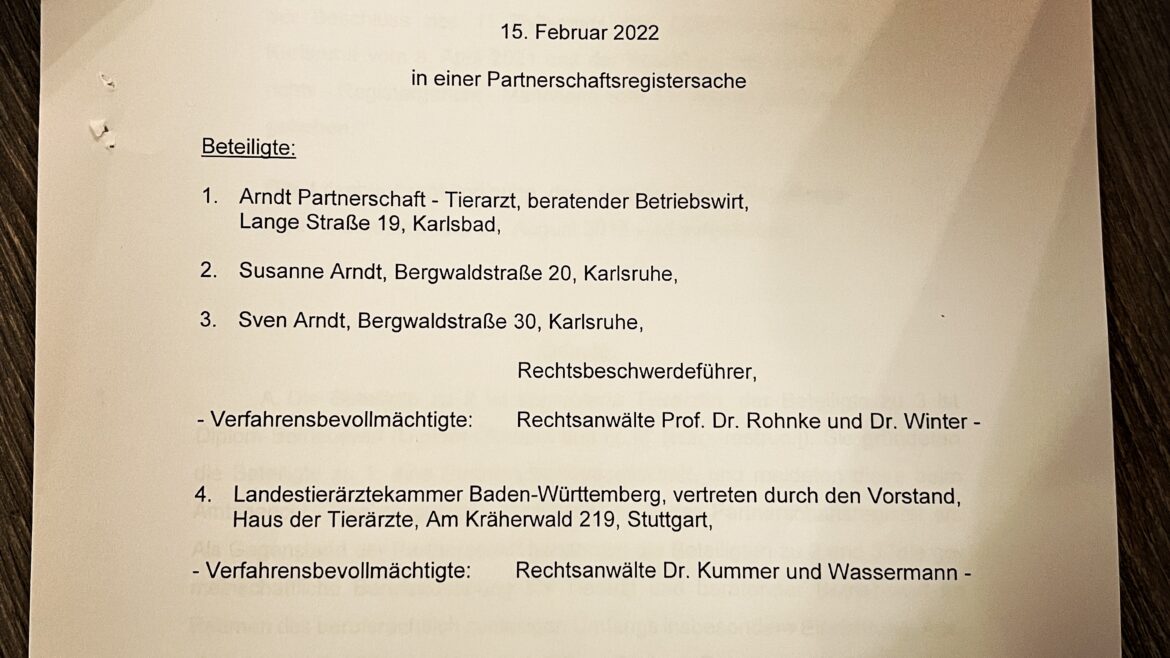
Veterinarian Susanne Arndt operated three small animal practices in the Karlsruhe area, typically as a sole proprietorship. With increasing growth, she wanted to convert them into a limited liability company (GmbH). However, the German Transformation Act (Umwandlungsgesetz) requires a registered legal form for this (even if it's just a registered merchant). The latter isn't possible for a self-employed professional, as they aren't considered merchants. Therefore, the only option was to establish a partnership – consisting of self-employed professionals (in this case, the veterinarian and a business administrator). The partnership was founded and registered with the Mannheim Local Court (AG Mannheim).

The case:
The Baden-Württemberg State Chamber of Veterinary Surgeons applied for the dissolution of this company pursuant to Section 21a of the Professional Code of Conduct, as its code of conduct stipulates that a partnership is only permissible between veterinarians. Paradoxically, it simultaneously suggested to the two partners that they could implement their project as a limited liability company (GmbH) instead!

The decision of the Federal Court of Justice (BGH) of 15 February 2022 – II ZB 6/21 – Higher Regional Court (OLG) Karlsruhe / Local Court (AG) Mannheim:
„"A partnership between a veterinarian and a business administrator is permissible under the Baden-Württemberg Chamber of Health Professions Act."“

The Federal Court of Justice's (BGH) reasoning:

The professional code of conduct of the LTK BW is not a formal state law, which is why the BGH was able to decide without involving the BVerfG.

Section 21a of the Professional Code of Conduct violates the priority of Section 30a Paragraph 1 Sentence 2 of the Baden-Württemberg Chamber of Health Professions Act (hereinafter: HBKG BW), according to which veterinarians may run a practice jointly with persons who belong to a state-approved training profession in the health sector, a natural science profession, or a social education profession, in accordance with Section 2 Paragraph 1 No. 3 HBKG BW.

The interprofessional associations of chamber members permitted by the HBKG BW cannot be restricted by the chambers' statutes.

Therefore, there are no public interest considerations that would preclude interprofessional collaboration with a business economist (among other things due to Art. 12 para. 1 GG – freedom to practice one's profession, but also §30a HBKG BW is not to be understood as conclusive).

Such cooperation does not contradict the purpose of the HBKG BW, because "the definition of permitted forms of professional practice should ensure compliance with professional obligations in healthcare activities in all legal forms of organization "It could be enforced."“

At this point the The reasoning behind the verdict is interesting., because it goes on to say:

„"The legislator intended to fundamentally exclude commercial medical practice. Commercial activity is defined as partnerships and legal entities, but not members of the liberal professions… which include business administrators… Only for medical practice within legal entities has the legislator established detailed requirements in Section 30a Paragraph 2 of the Baden-Württemberg Health Care Act (HBKG BW) to exclude commercial medical practice."“

And this is particularly interesting when you take a closer look at this paragraph:

§ 30a (2) HBKG BW:
The professional activity of a healthcare provider for a legal entity under private law presupposes that

  1. The company's purpose is the exclusive performance of medical professional activities.,

2. all shareholders are persons as defined in paragraph 1 sentence 2,

3. the majority of the company shares and voting rights are held by chamber members in accordance with Section 2 Paragraph 1 Numbers 1 to 3 or Number 5 and company shares are not held on behalf of third parties,

4. at least half of the persons authorized to manage the business are chamber members in accordance with Section 2 Paragraph 1 Numbers 1 to 3 or Number 5,

5. a third party does not participate in the company's profits,

6. sufficient professional liability insurance exists for the legal entity under private law and the professionals working therein and

7. It is ensured that the medical professional activity is carried out by the chamber members in accordance with Section 2 Paragraph 1 Numbers 1 to 3 or Number 5 on their own responsibility, independently and not commercially.

Further details are regulated by the respective professional code of conduct.

If one follows this passage of the HBKG BW, to which the Federal Court of Justice (BGH) explicitly refers – what does this mean for chains like Evidensia or Anicura in Baden-Württemberg? Shouldn't the Baden-Württemberg State Chamber of Veterinary Surgeons intervene immediately and ban them?

Furthermore, the Federal Court of Justice's statements on the subject are extremely interesting. Duty of confidentiality of the veterinarian:

„"Finally, a veterinarian (§ 2 para. 1 no. 3 HBKG BW) – unlike the chamber members further covered by § 30a para. 1 sentence 2 … does not possess a right to refuse to testify pursuant to § 53 para. 1 no. 3 StPO. In contrast to the other chamber members … a veterinarian does not have a special relationship of trust with his client, which includes and requires the protection of legitimate confidentiality interests (cf. BVerfGE 38, 312, 323 f.)."“

Conclusion from our perspective:

  • Not everything that state veterinary associations write in their professional codes of conduct is untouchable.
  • The State Chamber of Veterinary Surgeons of Baden-Württemberg has received a clear mandate, based on the explicit reference to Section 30a Paragraph 2 of the Baden-Württemberg Animal Welfare Act (HBKG BW), to review the chains operated by financial investors in this region and to take appropriate action.
  • We are eager to see if this will happen and thus ensure legal certainty!
Financial investors and the trend towards veterinary chains
Financial investors and the trend towards veterinary chains 681 1024 Sven Jan Arndt

1. Current trend

The spectacular takeover of Germany's largest veterinary chain, Anicura, by Mars Petcare caused a stir at the beginning of June (we reported on it: https://doc4pets.de/anicura-schliesst-sich-mars-petcare-an/Now a new "chain" – Vetsana?

And already the next financial investors are waiting in the wings, promising the selling and acquiring veterinarians the moon. Currently, for example, Vetsana GmbH (a nice name – it sounds very reputable and like a veterinarian) from Munich is getting started. They are committed for the long term (10-15 years) and are all entrepreneurs. We noticed them because they are using quite a lot of marketing in the Grüner Heinrich area and at... Wir-sind-Tierarzt.de act as an advertising partner.

Unlike the big chains, they are friendly and approachable. Every young veterinarian has the freedom to develop their skills. The selling veterinarian knows their practice is in good hands. Etc. etc.

They always prefer to have a majority when they take over a practice – quote:  Yes, typically we acquire a majority stake in the practice. We very much like it when the managing veterinarians take a significant stake in their own practice as partners. This is not mandatory, but it is an option. The size of the stake is flexible within this framework.“

2. Vetsana – a new concept?

Let's take a look behind this new construct, which aims to do everything better than the other chains:

a) There are no veterinarians among the investors – how can economies of scale, which one supposedly wants to leverage, be utilized? „"And a consortium naturally has further advantages, for example in purchasing, training and the exchange of know-how."

b) Legally, this construct, like Evidensia and Anicura, stands on very shaky, national ground. The state veterinary associations largely stipulate who must be involved in a practice and by what majority. The Westphalia State Veterinary Association specifies this in great detail:

§ 28 Veterinary association in the legal form of a legal entity under private law

(1) Veterinarians are permitted to operate a solo practice or a joint practice in the legal form of a private legal entity. The following conditions must be met to operate a company in the form of a private legal entity: 1. The company must be managed responsibly by a veterinarian, 2. The majority of managing directors must be veterinarians., 3. The majority of the company shares and voting rights must be held by veterinarians, or, based on company agreement provisions, the powers for resolutions relating to the professional code of conduct of the Westphalia-Lippe Chamber of Veterinarians, the veterinary professional law, and the rights and obligations of veterinarians arising from applicable law must be irrevocably transferred to a body in which licensed veterinarians hold the majority of the voting rights. 4. Every veterinarian working in the company must have adequate professional liability insurance; in the case of partnerships with limited professional liability, priority must be given to Section 8 Paragraph 4 of the Law on Partnerships of Members of the Liberal Professions.“

It's actually quite remarkable that the state veterinary associations establish professional codes of conduct but don't enforce them. Why not, one wonders? Fear of EU law? As an ordinary citizen, one has to wonder what the point of laws and regulations is then!

c) Which veterinary practices has Vetsana already taken over!?

d) What kind of return does such a private investor expect when making such a long-term commitment? Those who, by their own admission, only want to exit after 10-15 years typically demand a substantial multiple of their group's revenue. In other words, the veterinarians being acquired must, of course, dramatically increase their revenue during this period to make a proper exit possible. We're talking about revenue increases of 25-301,000 per year – otherwise, in our opinion, it doesn't make sense for such a "private investor." From our perspective, the problematic aspect is the prospect for the young veterinarian who has poured their heart and soul into their practice for 10 years, only managed to acquire a maximum of 491,000 per year, and is now being sold to another investor (e.g., Mars Petcare) without having any say in the matter. And what will happen to them there? Will they really be able to continue developing their practice as they wish?

3. A look behind the scenes

Let's take a deeper look behind the scenes., Which is something the editors of Wir-sind-Tierarzt.de don't seem to have done very carefully. While they're usually so proud of their critical reporting, they seem to quickly forget their critical distance when "the money's rolling in"—which, to be fair, they did acknowledge in the end. Disclosure: VetSana is a sponsoring partner of wir-sind-tierarzt.de for the summer months of 2018. This article was created as part of this advertising partnership – you can read more about this form of collaboration here.“

According to the commercial register, the shareholders of Vetsana GmbH are Mr. Ulrich Biffar (Switzerland) with 63.11 TP3T, Pelecanus GmbH with 26.761 TP3T, and Mr. Florian Arndt with 7.8881 TP3T and Mr. Uwe Bühler with 2.2521 TP3T. Mr. Felix Hauser is behind Pelecanus GmbH.

Mr. Biffar, Mr. Hauser, and Mr. Arndt all hold leading positions (managing directors) at Lamont Capital GmbH – also located in Munich. According to their own statements, they use this company to invest in highly profitable businesses. „"Lamont Capital is a Munich-based company that focuses on advising on the acquisition and ongoing support of medium-sized companies. The investments focus on majority stakes in companies in German-speaking countries with an enterprise value between €10 million and €75 million that are sustainable and above average in terms of profitability."“

Now, of course, the question immediately arises – how many weddings can one dance at? Not just a little bit, but professionally? So that the dance partner also enjoys it and doesn't end up with a bunch of bruised feet after the dance. 😉

Mr. Ulrich Biffar was also the head of the German branch of the financial investor Bain Capital. Mr. Arndt and Mr. Hauser also worked at Bain Capital. Bain Capital is known for its rather aggressive approach to its investments.

„"Bain Capital is accused of exploiting various companies and causing their subsequent bankruptcy:

GS Technologies, a steel mill in Kansas City, had been operating since 1888. In 1993, Bain acquired a majority stake, but barely ten years later the company was bankrupt. According to a report by the US television network MSNBC, 750 people lost their jobs at that time. Bain, on the other hand, profited from the deal: the company reportedly earned twelve million dollars, having initially invested only eight million dollars. In addition, Bain apparently pocketed at least 4.5 million dollars in consulting fees. [4][5]

In 1992, Bain Capital acquired American Pad & Paper. By 1999, two of the company's factories had closed, 385 jobs were lost, and the company was $392 million in debt. In 2000, the company filed for bankruptcy. [6] The Boston Globe reported that Bain earned US$100 million from Ampad, on an investment of US$5 million, including several tens of millions in management fees. [7]

Bain Capital and Goldman Sachs acquired Dade International in 1994 for approximately US$450 million. Around 900 jobs were eliminated or outsourced. Over the next few years, another 1,000 workers were laid off, and the company's debt quadrupled. The company declared bankruptcy in 2002. [8][9]

In 1997, Bain Capital bought LIVE Entertainment for US$1,104,400. Subsequently, one in four of the 166 employees were laid off. [10] Bain Capital made a profit of US$578 million through the companies Stage Stores, American Pad & Paper, GS Industries, Dade, and Details; all five companies went bankrupt shortly afterwards. [11]“

4. Outlook

A cynic might now think something sinister about the sentences from the aforementioned – let's call it an "advertorial" from Wir-sind-Tierarzt.de:

 VetSana It was founded by German entrepreneurs led by Florian Arndt and myself. We invest our own money. There is no investment fund or other form of venture capital behind it, nor is there any other company from the veterinary medicine sector involved.
We are private investors with a long-term investment horizon. We see this as a 10- to 15-year project. Only then will our commitment and investment pay off. We want to build a long-term and sustainable partnership with our veterinarians to achieve this.“

It's great that there will finally be a "good veterinary chain"...